A Mighty Fortress Is Our God: A Tribute to Pierre Trimbach
-
Stephan Reinhardt
- 04 Feb 2026 | News & Views
His wines are like his handshake: if it's too strong, you're too weak. Pierre Trimbach didn't just hold out his hand to greet and bid farewell; he took yours and squeezed it. Some say he crushed it. Like a vice that smiles. Pierre Trimbach was always engaging. He wasn't a spontaneously open-hearted person like the Catholic Rhinelanders further north, but he was reliable. His handshake was more stable than ink on paper. He got along with anyone he shook hands with. Working hands. Not those of a desk jockey. Pierre Trimbach didn't have to sell wine. He just had to produce it. His brother Jean was responsible for sales and communication, and later his older daughter Anne became responsible for those as well.
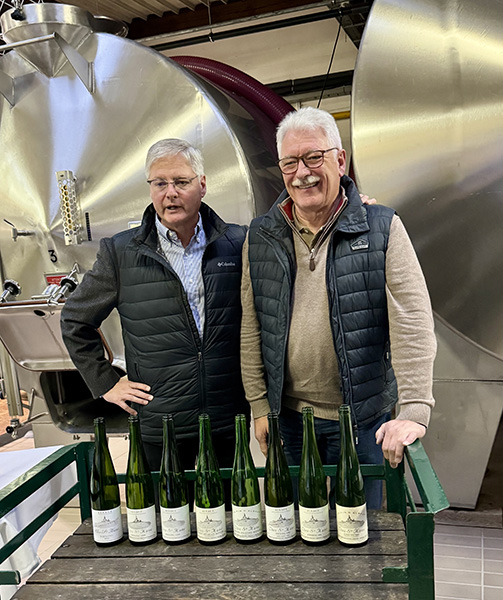
The wine tastings at Maison F. E. Trimbach in Ribeauvillé went like this: welcome, assignment of seats and off we went. Thirty wines in two hours. Quick, quick, quick. Pierre didn't actually sit down. He remained standing. Leaning forward, one hand resting on the table, the other on his hip. He stood there like a cowboy. And always four wines at a time. Or six. Always in pairs. Two grands crus side by side or three vintages of one grand cru. He spoke little or not at all. He just stood and waited. He took his time, but he left the talking to his brother Jean. He's good at that. Better than most in Alsace. The wines spoke for themselves. But because Jean could never be sure that they were understood correctly, he translated. The words were usually more beautiful than the wines. The wines were like Pierre's handshake: firm, clear, uncompromising and unyielding. I had never had a Trimbach Riesling or Gewürztraminer that would have curried favor with me—or with the market, which would have been even more important. Pierre benefited from the fact that 11 generations before him had produced Trimbach wines. He didn't have to reinvent the wheel when he joined the business in 1979. He had his knowledge and his faith in Riesling—and the Alsatian terroir.
Have we ever had a Trimbach Riesling in our glass that tried to seduce us? Especially when it was young?
Whether Clos Sainte Hune from the grand cru Rosacker, Osterberg, Geisberg, Schlossberg, Brand or the Cuvée Fréderic Emile, these wines don't caress your soul; they rob you of your senses. They challenge you to engage with them. A spontaneous "Oh, fine! How delicious!" rarely escapes you with Trimbach. Alsace is not the Moselle, and the terroirs around Ribeauvillé are certainly not. The shell limestone and yellow limestone that characterize the powerful, always distinctive and always dry Clos Ste. Hune could also have built the fortress that Martin Luther sang about 500 years ago: "A mighty fortress is our God."
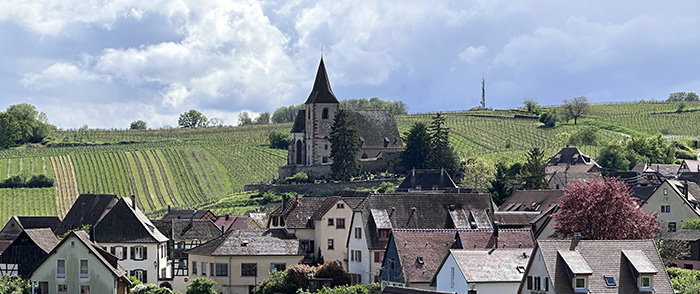
Confessions of one's own faith: that's what the wines were that Pierre Trimbach produced until recently. For 47 vintages. Trimbach wines need time, preferably a large glass and, ideally, a decade or even several decades of bottle aging. When the family invited guests to Ribeauvillé and then to the Auberge de l'Ill in November 2024 to celebrate the release of the 2019 vintage and the 100th anniversary of Clos Ste. Hune, they were able to experience the unique character of this Riesling from an old 1.67-hectare parcel in the microclimatically diverse southeastern part of the Rosacker. The wine simply does not age, at least not if it has been stored properly. A monument. Formerly somewhat leaner and racier, today it is complex and powerful, like the Église Saint-Jacques-le-Majeur, whose image adorns the label of perhaps the most famous Riesling in the world. Built to protect the faithful, the church is on the southern edge of the commune of Hunawihr. Alsace has often been the scene of terrible wars and persecution. The fortified church and the commitment to one's own faith were essential for survival—and probably also for creating a sense of identity.
The Riesling must be dry and suitable for gastronomy. To ensure that it did not simply get stuck during the fermentation process, Trimbach ensured a sufficient supply of nutrients in the vineyard, which is now organically farmed. He tackled the weeds around the vines with a hoe rather than a machine. After all, there shouldn't be too much competition for the few nutrients available.
The grapes are destemmed and placed in the press. Thanks to fermentation starters, the musts ferment mostly in stainless steel but sometimes also in wooden barrels and concrete. Fermentation should be complete and the wine bottled by spring. No malolactic fermentation, as this does not correspond to the fresh, angular, mineral and, in its youth, quite robust style of the Trimbach house.
On my next visit, I would have liked to talk to Pierre about the global wine crisis, which is particularly affecting Riesling, which many consumers find too sweet, too sour, too complicated or all of the above. Would Trimbach, with its wines shaped by terroir and viticulture, perhaps want to change with the 13th generation? According to the motto: tradition can only live on if you change, not pandering to modern preferences but accommodating them to a certain extent.
I think Pierre would have just smiled and said, "Non." And, referring to 400 years of family winegrowing, he would have poured the next series into our glasses.
That will no longer happen. Last Saturday afternoon, Pierre Trimbach had a car accident on the road between Ammerschwihr and Ingelheim, in the middle of vineyards. Shortly afterwards, he succumbed to his serious injuries in hospital. He was 69 years old. It is as if a fortress has been robbed from us and the whole of Alsace.
Unwavering, always following his own path, Pierre saw the bigger picture, and Maison Trimbach was successful worldwide. But he was always committed to the wines and winemakers of Alsace and was a role model for other producers. His passing is not only a family tragedy but also one for the entire Alsace region and Riesling worldwide. With Pierre Trimbach's death, nothing less than a fixed star over Ribeauvillé has been extinguished.
We at Robert Parker Wine Advocate would like to express our deepest condolences to the family and all the employees and friends of Maison Trimbach, which can look back on 400 years of history this year. We will remember Pierre forever and commemorate him with every glass of Trimbach. Furthermore, we are convinced that the 13th generation, led by Anne, Frédérique and Julien, will continue the future in the spirit of the house's glorious tradition.